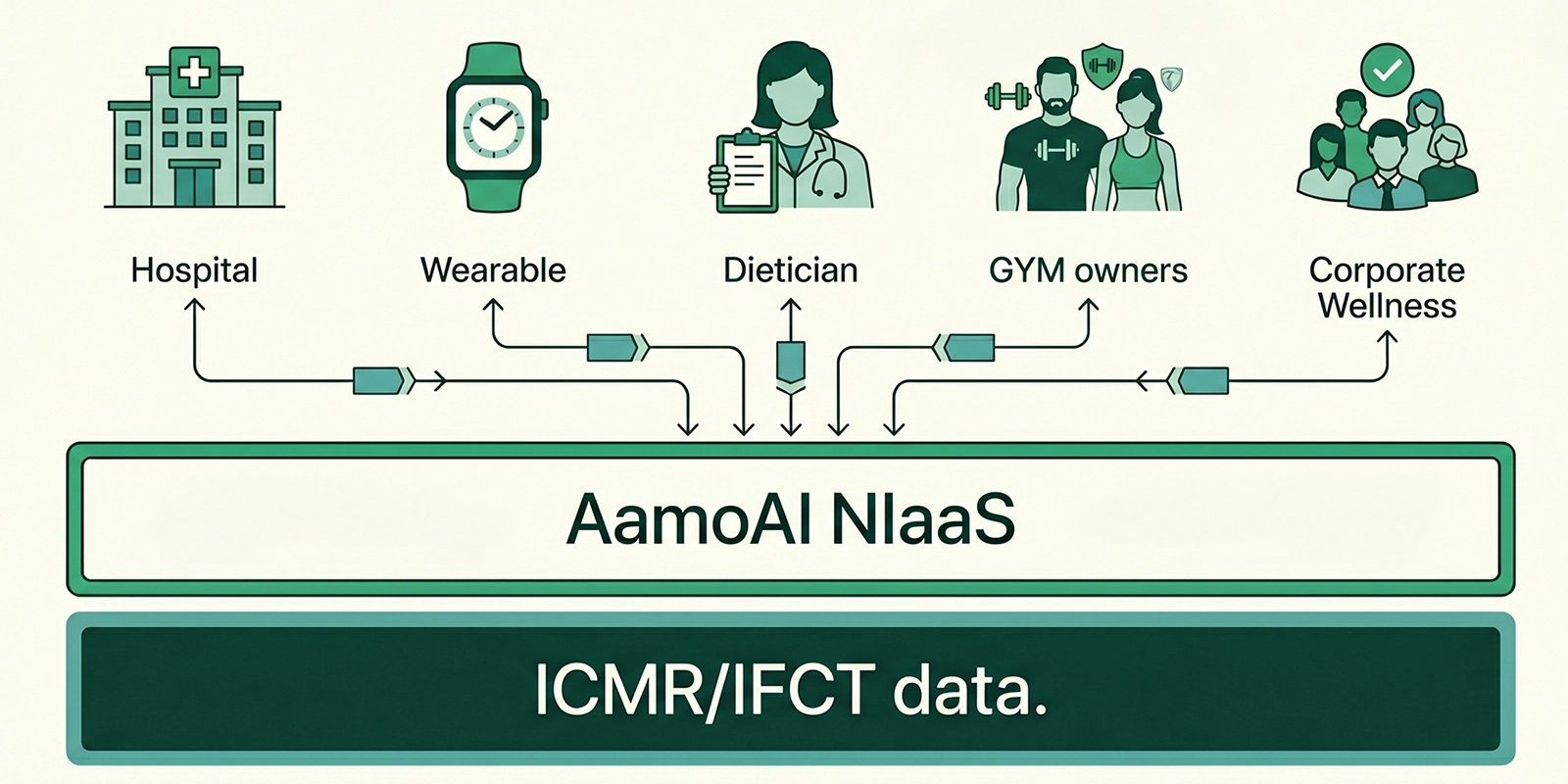
Why India Needs a Nutrition Operating System, Not Another Diet App
Open any app store in India and you'll find dozens of calorie counters, macro trackers, and AI meal planners. Most of them work reasonably well — for someone in California. What India actually needs isn't another consumer app layered on top of Western nutrition logic. It needs nutrition tech built as infrastructure from the ground up — a true nutrition operating system India can build its hospitals, wellness platforms, and dietician software on.
That distinction — app versus infrastructure — is the difference between a feature and a foundation. This post explains why infrastructure is the harder, more important problem, and why we believe it's the one worth solving first. (At
AamoAI™
, this is the problem we work on daily — more on that toward the end.)The Diet App Model Has a Ceiling
Diet apps are built to serve one user, one goal, one moment. Log a meal, see a number, get a nudge. That model works reasonably well for simple calorie awareness on an individual level. It breaks down the moment real-world complexity enters the picture — and in India, complexity is the default, not the exception.
Think about what a single app would need to do well to genuinely serve the Indian market: understand a Gujarati thali differently from a Bengali one, adjust for a joint family where three generations eat from the same kitchen with three different health needs, account for a fasting day during Navratri, and still produce a number that means something clinically. Most consumer apps simply don't attempt this. They average everything into generic "Indian food" categories and call it personalization.
- A hospital dietician managing forty renal patients can't rely on an app meant for individual logging — they need consistent, auditable, patient-specific data at scale.
- An insurance company scoring wellness across a million policyholders needs programmable data they can run calculations against, not a UI built for one person at a time.
- A quick-commerce platform recommending pantry swaps needs an Indian food data API healthtech teams can query in milliseconds, returning structured nutrient data — not a screen a person taps through manually.
- A wedding or event caterer planning menus for five hundred guests with varying dietary restrictions needs bulk, structured output — not a single-serving meal suggestion.
None of these are app problems. They're infrastructure problems. And infrastructure doesn't get built by adding more features to a consumer app — it gets built by designing the data and logic layer underneath everything, from scratch, for the systems that will actually use it. This is a slower, less visible kind of work. It doesn't generate app store screenshots. But it's the layer every downstream product eventually depends on.
Why "Automatic Menu Planner" Isn't the Real Ask
It's tempting to frame the opportunity as "build a better automatic menu planner." But menu planning is an output, not a foundation. The real question enterprises ask isn't "can you suggest a meal?" It's "can your system tell me, reliably, what's actually in this meal, how it behaves in an Indian body, and whether it's safe for this specific patient?" That requires personalized nutrition logic sitting on verified data — not a recommendation engine guessing from incomplete inputs.
Indian Nutrition Intelligence Needs an Indian Foundation
Most nutrition platforms operating in India still lean on USDA-style food composition data, adapted loosely for "South Asian" food. The problem is that Indian food doesn't average well. A dal in Punjab and a dal in Kerala can differ enormously in fat content, glycaemic load, and micronutrient profile, depending on regional ingredients and cooking method.
Real Indian nutrition intelligence has to start from Indian data:
- ICMR's Recommended Dietary Allowances, revised for Indian body composition and activity patterns
- The Indian Food Composition Tables, mapping nutrient values for indigenous ingredients and regional preparations
- Cooking-method adjustments — tempering, slow-cooking, fermentation — that change how a food behaves nutritionally
This is what an ICMR nutrition layer India actually means in practice: not a marketing label, but a data foundation that reflects how Indians actually eat, cook, and absorb nutrients — including factors most apps ignore entirely, like electrolytes, fluids, and the effect of heat on daily nutrient and hydration needs. ICMR's own water and hydration guidelines, for instance, scale fluid requirements by body mass and activity level specifically for Indian climatic conditions — a level of nuance a generic Western database simply doesn't carry. You can review the underlying recommendations directly via the ICMR-National Institute of Nutrition.
Heat, Fluids, and the Gap Most Apps Miss
India's climate is not a footnote in nutrition planning — it's a core variable. Large parts of the country experience extended heat stress for much of the year, which changes fluid and electrolyte requirements meaningfully. A nutrition system that doesn't adjust sodium, potassium, and water guidance for seasonal heat is giving incomplete advice, especially for outdoor workers, athletes, elderly patients, and anyone managing chronic conditions. Public health bodies like the World Health Organization have flagged heat-related health risk as a growing concern globally — and India's exposure is higher than most. A genuine nutrition operating system India needs to bake this into its core logic, not bolt it on as a seasonal tip.
What "Nutrition Intelligence as a Service" Actually Means
This is where the infrastructure model — sometimes called NIaaS India, or Nutrition Intelligence as a Service — becomes useful as a concept. Instead of one app trying to serve every use case, NIaaS treats nutrition logic as a backend service that other platforms plug into, the same way payment gateways or mapping services became invisible utilities other businesses build on top of.
In practice, this looks like a nutrition API India healthtech, hospital, and wellness companies can integrate directly:
- Hospitals pull therapeutic diet logic for renal, diabetic, or cardiac patients automatically, instead of building it manually per patient — saving clinical dietician time for the conversations that actually need a human
- Corporate wellness platforms generate meal-based wellness scores grounded in ICMR-aligned thresholds, rather than generic global benchmarks that don't reflect Indian baseline health data
- Dietician software gets a verified data layer underneath it, so practitioners spend time advising, not cross-checking nutrient values by hand against PDF tables
- Grocery and quick-commerce apps offer pantry-aware suggestions using real ingredient-level data, down to regional variants of the same staple
- Fitness and performance platforms build Indian-food-native plans for athletes, rather than translating Western macro targets onto Indian meals after the fact
The common thread: none of these companies want to build a consumer nutrition app. They want to embed nutrition intelligence into the product they're already building. That's a fundamentally different ask than "give us a meal planner" — and it's the one infrastructure is built to answer. An AI meal planner bolted onto incomplete data will always be limited by that data; a properly built API layer raises the ceiling for everything built on top of it.
Why This Matters for Healthtech Infrastructure in India
Healthtech infrastructure India has matured rapidly in areas like diagnostics, telemedicine, and electronic health records. Each of those categories went through the same arc: early consumer-facing tools proved demand, and then a wave of infrastructure players built the verified, scalable backend that the entire industry now relies on. Diagnostics labs didn't scale because of a single popular app — they scaled because standardized testing protocols and shared data formats let any clinic plug into the same trusted system.
Nutrition has lagged behind this pattern — not because demand is low, but because the underlying data work is genuinely hard. Mapping thousands of regional ingredients to verified nutrient values, adjusting for cooking technique, accounting for seasonal and regional variation, and aligning everything to ICMR standards is slow, unglamorous work. It's also exactly the kind of work that, once done properly, becomes reusable across an entire industry rather than locked inside one app. The first mover here isn't necessarily the one with the flashiest interface — it's the one with the most rigorously verified data underneath.
What Builders Should Look For
If you're evaluating nutrition technology to embed into your own healthtech, wellness, or food platform, a few questions are worth asking directly:
- Is the underlying nutrient data based on IFCT and ICMR sources, or adapted from a non-Indian database?
- Does the system account for regional and cooking-method variation, or treat every "dal" or "roti" as one fixed value?
- Can it be accessed as an API, or only through a fixed app interface?
- Does it factor in real Indian conditions — heat, hydration, electrolyte needs — or only static calorie counts?
- Is it built to scale across thousands of patients or users, not just one person logging meals?
If the answer to most of these is no, you're likely looking at a diet app wearing infrastructure language — not infrastructure itself.
Our Approach at
AamoAI™
This is the exact gap AamoAI™
You can read more about how we think about this on our about page, or explore what we're building for partners on our homepage.
Conclusion: Infrastructure Outlasts Apps
Diet apps come and go. Trends shift, UI preferences change, and consumer attention is fickle. Infrastructure, when built correctly, becomes the layer everything else depends on — quietly, for years. India's nutrition data problem won't be solved by a better app. It will be solved by treating nutrition intelligence the way we treat payments, logistics, or identity: as infrastructure that's verified once, built properly, and reused everywhere.
If you're building in healthtech, wellness, or food, and you're tired of nutrition logic that doesn't reflect how India actually eats — we'd like to talk. Get in touch with AamoAI™
Translate insights into your client plans.
Use AamoAI™ to build culturally-grounded meal plans in minutes — not hours.